KNITTERS IN RESIDENCE
Hawksbill Sea Turtle
Welcome! This page is your space for exploration. Here you’ll find selected readings, talks, and visual references. The material offers a bit of context around storytelling, ocean literacy, and how knitting can carry ideas or meaning. Take what you need, skip what you don’t, and let it spark your own direction.
This third cohort links knitting with the Hawksbill Sea Turtle. A collaboration with the conservationists, researchers, tourism centers and more.
Photo credit: Nature Seychelles
Storytelling in Textile Traditions
Textiles have always carried memory. Across cultures, pattern and colour act as repositories of knowledge and belonging.
Key examples
Andean weaving: Records social and geographic information through coded warp sequences.
Sámi gákti: Garment colours and trims communicate region and family lineage.
West African Kente: Each motif corresponds to a proverb or historical event, forming a wearable archive.
Research connection
Anthropologist Elizabeth Barber calls this embedded knowledge. Information stored in material form. Repetition sustains continuity; motif preserves history.
Tips for practice
Study pattern logic rather than symbols. How repetition conveys meaning.
Explore colour as language: Assign value, tone, or direction.
Use scale to shift intimacy. From body-held to room-held.
Reflect on what kind of knowledge your own piece could preserve; environmental, cultural, emotional.
How far can one story travel?
A simple knitting pattern shared online can reach as many people as a scientific report, maybe more, because it’s personal. It’s human. And that’s often how change begins; with something people can hold, make, and feel connected to.
Knitting has always travelled, through patterns passed on, garments worn, and stories retold.
In this residency, story reach is about how a textile can be shared; through pop culture, social media, or daily use. How can a piece designed in one place carry meaning somewhere else?
Consider:
Visibility: Could your design spark curiosity beyond the knitting community? What would make someone stop and ask about it?
Translation: How can colour, texture, or structure tell part of the story without words?
Reproduction: What happens when others knit your pattern? How might they reinterpret or expand the story?
Mediums: Could the piece be photographed, filmed, or styled in ways that extend its meaning into other arenas - streetwear, exhibitions, or everyday life?
The aim is to create something that moves. A story with reach.
Knitting can turn complex information into structure. Data becomes pattern; rhythm becomes form.
Documented examples
The Tempestry Project (US): Knitters transform daily temperature data into colour-coded stripes to visualise climate change.
Kate Davies (Scotland): Her collection Shorelines interprets coastal geography and tide patterns through motif and gradient, connecting design to place.
Rikke Sørensen (Norway): Uses charted stitch sequences to represent sound waves recorded along the coast
Why it matters
Research on craft translation describes how physical repetition helps audiences grasp systems that numbers alone can’t express.
Tips for practice
Choose one measurable element (temperature, tide height, species count).
Translate it through colour, density, or stitch rhythm.
Record your conversion system so others can replicate or adapt it.
Examples
The Knitting Map (Ireland)
By: Jools Gilson & Richard Povall (2005, Cork).
What: 2,000 knitters created a 9 × 9 metre textile recording movement patterns of people walking through Cork City over a year, translated into stitch sequences.
Why it matters: Demonstrates large-scale participatory knitting as social mapping, community data turned into textile narrative.
Source: knittingmap.com
The Red Sweater Project (Kenya)
By: Local women’s groups collaborating with artist Marion Coutts (featured in Textile: Cloth and Culture, 2011).
What: Sweaters knitted collectively to raise funds for school uniforms; each garment becomes a link between maker and recipient.
Why it matters: Connects communal making to education, social empowerment, and local economy, knitting as infrastructure for care.
The Great Tapestry of Scotland
By: Artist Andrew Crummy with writer Alexander McCall Smith and historian Alistair Moffat (2013).
What: 1,000+ stitchers across Scotland embroidered 160 panels telling national stories.
Why it matters: While embroidery, not knitting, it’s a key model of large-scale communal textile storytelling.
Source: greattapestryofscotland.com
Each pattern in this residency will be published as open access. Freely available for others to make and learn from. Beyond that, there’s also room to think about what might happen next.
Some makers choose to build an extra layer into their work; an element that leaves space for co-creation or continuation in the future. It’s entirely optional, but can be a powerful way to let a design live on through new hands and contexts.
microRevolt/Nike Blanket Petition (Cat Mazza, US): A 13 × 15 ft knitted blanket incorporating 80,000 stitched signatures against sweatshop labour. Individual squares from makers around the world were assembled into one collective piece.
catmazza.comCrochet Coral Reef (Margaret & Christine Wertheim). An ongoing global collaboration where local groups crochet coral forms using shared algorithms. Each “reef” reflects its own community while connecting to the wider installation network.
crochetcoralreef.org
How to open up your design
Think modular: Use a section, border, or motif that could be extended, repeated, or joined with others later.
Add a joining point: A single stripe, colour band, or empty segment where new makers could attach their work.
Include a note for the future: A short line in the pattern text explaining that this design can evolve through collaboration or new interpretations.
Name the link: Give the project a shared tag or phrase (for example, Knit for Wildlife Pattern 01) so future versions can be connected back to yours.
Document your logic: Describe why you chose your structure, colours, or rhythm. That information is what allows others to build on it meaningfully.
information
The residency combines independent creative work with a series of shared touchpoints: Webinars, mentoring sessions, and guest talks. Expect roughly 1 shared activities most weeks, depending on guest availability and the pace of your process.
During your first week, the focus is on exploration. You’ll receive access to the private Inspiration Page, filled with visuals, readings, and background material to help with ideas for your design. And a group will be set up (instagram chat group) so you can stay connected, share updates, and exchange ideas with the other knitters throughout the residency
All sessions will be announced in advance, and recordings or short summaries will be available if you’re unable to join live.
🗓 September 2: Kickoff and hawksbill intro
Informal welcome & introductions.
Meet fellow knitters and Nature Seaychelles. Chris Tagg and Liz Mwambui will share the Seychelle/Hawksbill story.
Visual and storytelling intro to cohort theme
Sharing first reflections and idea sparks.
- Access the private inspiration page (Password: Hawksbill3rd) for visuals, articles, and ocean insights to assist your design ideas. Work independently.
🗓 September 4: Access to "Knit & Learn" with sea turtle researcher Alessia.
- Prepare your questions:)
🗓 week 37-38: Optional 1:1 w Lena
- Lena Fagerwing optional 1:1 based on your idea spark. Lena will curate visuals, context, and background stories to support your design.
🗓 Sept 18: Story session with Barbados Sea Turtle Project. Will come back with time.
- Meet the team behind the scene.
- Flexible check-ins with Lena available throughout the period.
🗓 week ?
Creating with plastic litter.
🗓 October: Inspiration and Guidance. More to come..
- Contribution from the UN Ocean Decade on ocean literacy and co-flourish, connecting creativity with sustainability.
🗓 week 42: Mid-residency MeetUp
- Informal group session to share progress, exchange ideas, and discuss what support or input might be helpful for the final stretch.
🗓 week 45-46:
- Technical Mentor from Kate Atherly/or her tech designer 1:1 sessions to review your open-access pattern and ensure clarity before publication. You will be able to send your pattern, she provides feedback and then you have a final possibility to get a feedback.
🗓 November 30: Design Submission
Submit your open-access pattern + 2-3 photos of your work. And a short reflection (50-100 words) about your idea or what inspired your design.
🗓 December 4: Virtual Toast
- We’ll gather for an informal online toast to celebrate what you’ve accomplished, exchange thoughts from the process, and mark the completion of the Knit for Wildlife residency together.
🗓 week 51/52: Public Launch
Your open-access patterns published digitally via knitforwildlife.org
Some patterns may be considered for limited editions or kits.
🗓 December 2026: Publication release
Release of a a cohort publication; featuring visuals, stories, and the residency’s outcomes.
If you need to check details, confirm sources, or discuss your project during the residency, please reach out to the contacts below.
Residency curator/project lead,
Lena Fagerwing
📧 hello@knitforwildlife.org
Lena is responsible for the overall Knit for Wildlife residency, project development, and content coordination.
Alumni "knit for wildlife"/Libby Rush
📧 libby.rush@knitforwildlife.org
Libby is always available if you have questions regarding knitting.
We’d love to share parts of your residency journey as it unfolds. Please feel free to share in your own tone; sketches, process notes, or reflections are all part of the story. The Instagram account @knitforwildlife will feature updates, work-in-progress, and insights from each of you. If you are posting on your own account - please tag @knitforwildlife
Lena will curate and repost selected content, sometimes as collab posts with @naturesey @barbadosseaturtle @unoceandecade or other relevant partners.
Hashtags to be used
#knitforwildlifemain hashtag for the residency#knitforwildlifecohort3For your group specifically.
SAMIL is Knit for Wildlife’s long-term yarn partner, providing South African yarn for our Knitters in Residence programme.
And there’s quite a story behind the fibre. South Africa produces more than half of the world’s mohair. With the Eastern Cape at the heart of the industry. SAMIL works across this fibre chain, from Angora goat farming in the Karoo to the processing of raw mohair.
Mohair itself is a pretty extraordinary material. Known for its lustre, strength, drape and durability, it comes from the Angora goat and requires highly specialised processing.
Through our partnership, Knitters in Residence will have the opportunity to work with SAMIL wool, mohair and mohair blends during their residency. Available yarns and colours will vary from cohort to cohort.
For the Hawksbill cohort: We’ll share the available SAMIL yarns with you soon. You are not required to use SAMIL yarn if another fibre is important to your design. We also have a discount code for yarn from "Knitting for Olive". See code and info further down on this page.
MEET THE CONSERVATION PARTNERS
These are some of the profiles/organizations we will work with for the 3rd cohort.
Nature Seychelles
On Cousin Island Special Reserve, Nature Seychelles manages one of the world's longest-running Hawksbill turtle monitoring programmes. Decades of protection, research and careful management have helped turn the island into one of the most important nesting sites for this Critically Endangered species—and one of the great success stories in marine conservation.
Barbados Sea Turtle Project
The Barbados Sea Turtle Project is based at the University of the West Indies (Cave Hill Campus). For more than 25 years, they have been involved in conservation of the endangered marine turtle species that forage around and nest on Barbados through research, education and public outreach as well as monitoring of nesting females, juveniles and hatchlings.
Alessia Lavigne
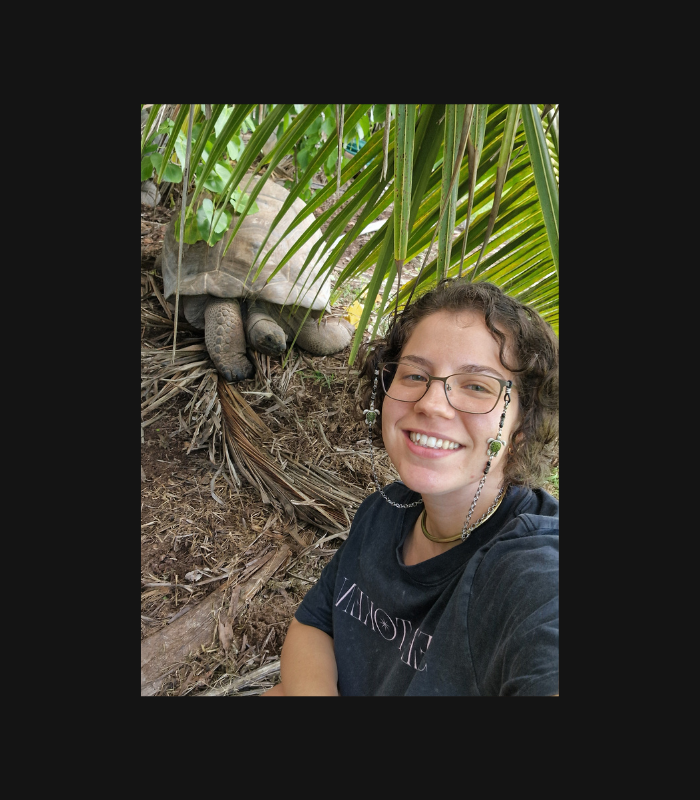
Alessia is a Seychellois zoologist and researcher working with sea turtle biology and conservation. Her research looks at one of the most fascinating and vulnerable stages of a turtle’s life: What happens inside the egg, and why some embryos never make it to hatching. Alessia will give our knitters a glimpse into a part of the turtle story we rarely get to see.
Mentors & Guests
Rita Johansen
A cultural heritage expert and former director of Vega world heritage foundation, responsible for safeguarding and promoting the UNESCO World Heritage linked to the eider down tradition.
Tormod Amundsen
Architect and founder of Biotope, the world’s first architectural office dedicated to birding and nature-based design. How can design conservation?
KNITTING FOR OLIVE
DISCOUNT CODE KFWaugust2026
Hawksbill Sea Turtles - Ocean Literacy
https://www.seaturtlestatus.org/
https://www.seaturtlestatus.org/articles/new-technology-tackles-tortoiseshell-trade
https://www.seaturtlestatus.org/articles/2015/picture-perfect-photography-for-turtle-monitoring
https://natureseychelles.org/what-we-do/marine-turtle-conservation/
https://oceandecade.org/news/knit-for-wildlife-stitching-marine-science-into-everyday-life/